How to fill out an Oregon catch record card
Oh, the infamous Oregon catch record card! It's one of those things that can feel like deciphering an ancient scroll, especially when you're out on the water, excited after hooking into a beautiful fish, and suddenly remember you need to fill out this little piece of paper. Many anglers, even seasoned ones, find themselves staring at the tiny boxes, wondering if they're doing it right. But don't you worry, because this guide is here to walk you through exactly how to confidently fill out your Oregon catch record card, ensuring you stay compliant and contribute to vital fish conservation efforts.
Understanding the Oregon Catch Record Card Requirement
Let's start by demystifying why these cards exist and who exactly needs to bother with them. It’s not just busywork; there’s a real purpose behind it all that benefits everyone who loves fishing in Oregon.
Why Catch Record Cards Exist
At its heart, the Oregon catch record card is a crucial tool for fish management and conservation. Imagine if the Oregon Department of Fish and Wildlife (ODFW) had no idea how many salmon, steelhead, or sturgeon were being caught and kept each year. It would be nearly impossible to set appropriate bag limits, determine seasons, or understand the health of various fish populations. These cards provide invaluable data. When you diligently fill out your card and submit it, you're directly contributing to the scientific data that helps ODFW make informed decisions about future fishing opportunities. This means protecting vulnerable runs while still allowing for sustainable harvest. It's a collective effort, and your participation truly matters.
Who Needs a Catch Record Card
Alright, so who needs one of these little paper guardians? Generally, if you're 12 years of age or older and planning to fish for certain highly managed species in Oregon, you'll need a catch record card. While your basic annual angling license covers a lot, it doesn't cover these specific, high-value fish that require more precise tracking.
For most recreational anglers, the need for a catch record card typically comes bundled with an endorsement or tag required for specific species. For instance, if you're pursuing salmon, steelhead, or sturgeon, you'll need a Oregon Combined Angling Tag Guide. This tag often includes or is accompanied by the necessary catch record card specific to those species. If you're heading out to target Pacific halibut, you'll need a Oregon Halibut Tag Requirements which also comes with its own separate catch record card. It's not a universal card for all fish; it’s specifically for those species where individual catch data is critical. Make sure you understand the Oregon Fishing License Age Requirements and how they relate to needing these tags and cards.
What Species Require a Card
As we just touched on, not every fish you catch requires a checkmark on a catch record card. The main players that absolutely necessitate careful recording are:
- Salmon: This includes Chinook, Coho, Sockeye, and Chum salmon. Both fin-clipped hatchery fish and wild fish (if retention is allowed) must be recorded.
- Steelhead: Both summer and winter steelhead, whether hatchery or wild (again, if retention is permitted in that specific area and time).
- Sturgeon: Specifically White Sturgeon. Given their protected status and strict slot limits, every retained sturgeon needs to be recorded, and often, even specific catch-and-release rules apply. Dive deeper into the specifics with the Oregon Sturgeon Tag Requirements.
- Pacific Halibut: This popular ocean bottom fish has very tight quotas and seasons, making accurate individual reporting essential. You'll find more details in the Oregon Halibut Tag Requirements.
Always consult the current Oregon Fishing Regulations Explained before heading out, as rules and species requiring cards can change, sometimes even mid-season due to emergency closures or quota fulfillment.
Getting Your Catch Record Card
Before you can fill it out, you need to actually have one! This section covers the practicalities of acquiring your card.
When and Where to Get One
The good news is that for most anglers, your catch record card isn't some extra, secret document you have to hunt down. It typically comes automatically when you purchase the necessary tag or endorsement for the species it covers. For example, when you buy your annual angling license and then add a Combined Angling Tag to target salmon and steelhead, your catch record card for those species will be issued right along with them.
You can pick up your license and associated tags/cards in a few convenient ways. Many folks prefer the ease of buying their Where to Buy an Oregon Fishing License online through the ODFW website. It’s straightforward, and you can usually print your license and tags right from home. This is often the quickest way to get started. Alternatively, you can visit a licensed vendor, which includes many sporting goods stores like Fisherman's Marine & Outdoor or even some hardware stores. They'll process your license and provide your physical catch record card on the spot. It's handy if you prefer a tangible item right away or need to ask a quick question. Just remember, don't wait until the last minute before your big trip to get it!
Physical Card vs. Digital Records
This is an important distinction to grasp. While you might be used to showing a digital image of your angling license on your phone to a game warden, the catch record card is a different beast. For salmon, steelhead, and sturgeon, the physical card is paramount. The regulations explicitly state that you must immediately record your catch on the physical card as soon as you retain a fish. This isn't something you can "get to later" or do on an app. You need that pen in hand, marking the card right there on the boat, on the bank, or wherever you landed your keeper.
For Pacific halibut, the ODFW often offers an electronic reporting option through their MyODFW app, which can be super convenient. However, even with this digital option, it's wise to carry a backup physical card or at least be prepared to make immediate notes, especially if you're in an area with spotty cell service. The key takeaway here is: always prioritize the physical card for salmon, steelhead, and sturgeon. Keep it protected, perhaps in a small waterproof bag, readily accessible. If you lose your primary card, it can be a real headache, so make sure you know What happens if you lose your Oregon catch record card.
Step-by-Step Guide to Filling Out Your Card
Okay, the moment of truth! You've got your card, you've landed a fish, and now it's time to mark it down. Let's break down each field to make sure you get it right.
Initial Information
Before you even wet a line, or at least before you retain your first fish, take a moment to ensure the basic identification details on your card are correct and filled out. This usually includes:
- Name: Your full legal name, matching your fishing license.
- ODFW ID / Customer ID: This is your unique identification number with the Oregon Department of Fish and Wildlife. It's usually printed on your license.
- License Number: Your annual angling license number.
- Year: The fishing year for which the card is valid. Oregon fishing licenses generally follow a calendar year, expiring on December 31st, regardless of when you purchased them. So, an Oregon fishing license for 2026, and its associated tags, will expire on December 31, 2026.
- Date of Issue: The date your license and card were issued.
Double-check these details against your actual fishing license. This prevents any issues if a game warden asks to see your credentials. You can always How to look up an Oregon fishing license purchase on the ODFW website if you need to confirm details.
Recording a Kept Fish
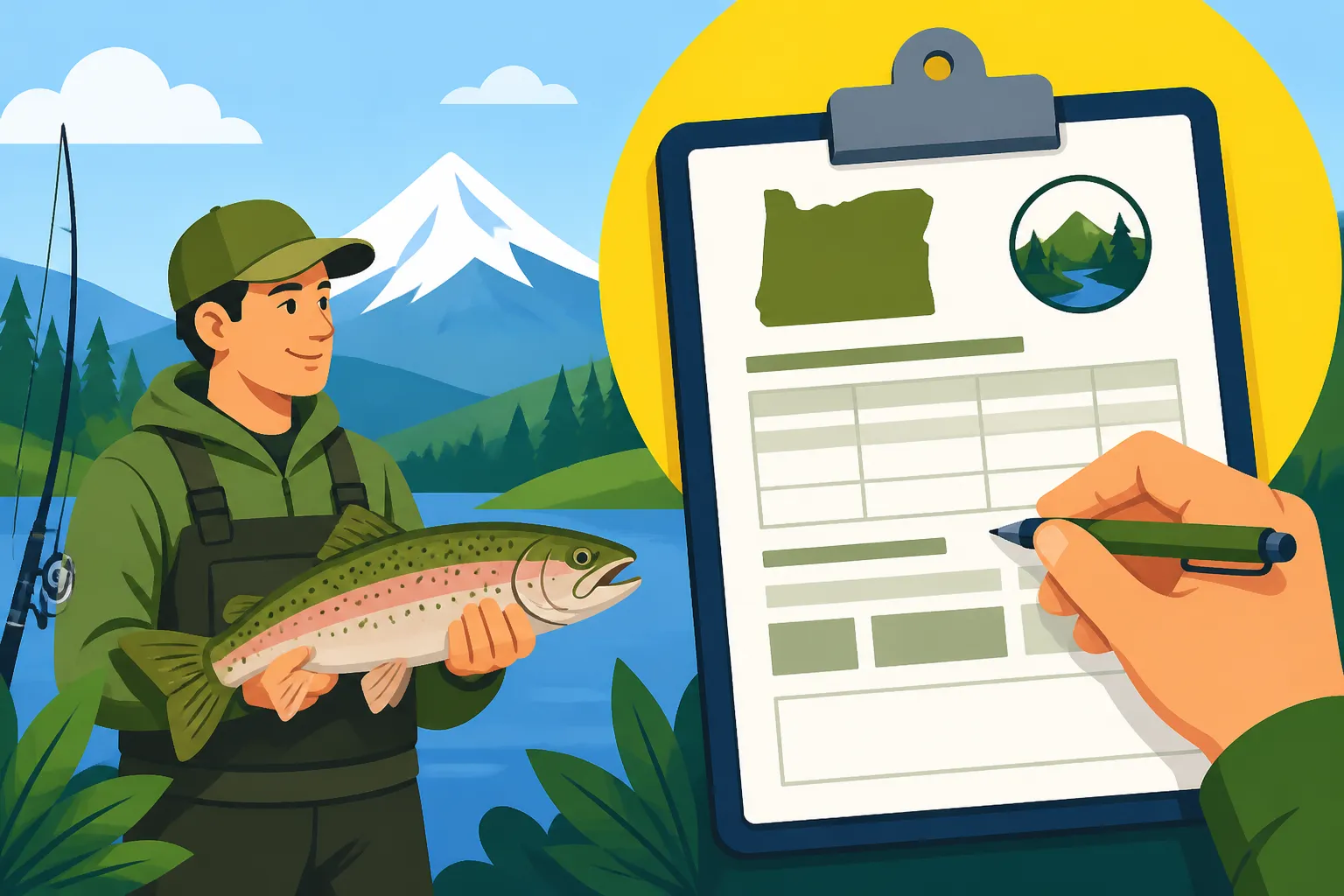
This is where the rubber meets the road. The most important rule is IMMEDIATE RECORDING. As soon as you decide to retain a fish that requires a mark on your card, stop what you're doing, even if the bite is hot, and fill out the necessary section. Failure to do so is a common violation and can result in penalties.
Let's break down the fields you'll typically encounter:
- Date: This is straightforward. Write the exact date (month/day) you retained the fish.
- River/Bay/Ocean: Clearly indicate where you caught the fish. For rivers, specify the name (e.g., "Columbia River," "Willamette River"). For bays, name the bay (e.g., "Tillamook Bay," "Yaquina Bay"). For ocean fishing, simply write "Ocean."
- Zone/Area: Many cards have a section for a specific zone or area code. This often correlates with the various Oregon Fishing Zones Explained ODFW uses for management. For example, the Columbia River might have different zones (e.g., "Lower Columbia," "Buoy 10"). The regulations booklet will detail these zones. If you’re fishing the lower Columbia River near Astoria, you might be in the “Buoy 10” zone during certain seasons. For the ocean, it might refer to a statistical area.
- Species: Mark the specific species you caught. Most cards have boxes for "Chinook," "Coho," "Steelhead," "Sturgeon," "Halibut," etc. Be precise! Don't just mark "Salmon" if there are distinct boxes for Chinook and Coho.
- Mark (Hatchery/Wild): This is critical for salmon and steelhead.
- Hatchery (H): This refers to a fin-clipped fish. Most hatchery salmon and steelhead in Oregon have their adipose fin (the small, fleshy fin on their back between the dorsal fin and the tail) clipped off. This is done when they are young to easily distinguish them from wild fish. If the adipose fin is missing, it's a hatchery fish.
- Wild (W): If the adipose fin is present and intact, it's a wild fish. In many areas and times, retaining wild salmon or steelhead is illegal or highly restricted, falling under Oregon Catch-and-Release Rules. If you are in a legal wild retention area, make sure to mark "W."
- Sturgeon: For sturgeon, you might also have a "mark" column, but it's typically used to indicate if the fish was marked by ODFW with a tag (like a gill plate tag) as part of their research, not a hatchery mark.
- Length/Weight (if required): For some species, particularly sturgeon, you might need to record the length. The Oregon Sturgeon Tag Requirements will specify if this is needed. Measure the fish accurately according to the regulations (e.g., fork length, total length). For halibut, sometimes weight is recorded if it's dressed.
- Gear Type (optional but good practice): Some cards or individual preferences might lead you to note the gear used (e.g., "Spinner," "Bait," "Fly," "Trolling"). While often not mandatory on the card itself, it can be useful for your personal fishing log or if regulations require specific gear in certain areas (like Oregon barbless hook requirements or bait restrictions on fly-only waters).
Here’s a table summarizing key fields for common species:
| Field / Species | Salmon/Steelhead (Combined Tag) | Sturgeon (Combined Tag) | Halibut (Halibut Tag) |
|---|---|---|---|
| Date | Required (Month/Day) | Required (Month/Day) | Required (Month/Day) |
| Location | River/Bay/Ocean name | River/Bay/Ocean name | Ocean |
| Zone/Area | Specific zone (e.g., Buoy 10) | Specific zone | Statistical area |
| Species | Chinook, Coho, Steelhead | White Sturgeon | Pacific Halibut |
| Mark | H (Hatchery-clipped) / W (Wild) | N/A (sometimes ODFW tag) | N/A |
| Length | N/A | Required (if kept) | N/A |
| Other | Check for Oregon Salmon and Steelhead Tag Requirements for specific notes | Check for Oregon Sturgeon Tag Requirements for specific notes | Check for Oregon Halibut Tag Requirements for specific notes |
Understanding Catch Codes and Zones
Sometimes, the card might have pre-printed codes or specific zones you need to reference. For example, "CR" might mean Columbia River, or specific numbers might correspond to different bays or ocean areas. The best place to find these codes and detailed zone maps is always in the official ODFW Oregon Sport Fishing Regulations booklet. You can usually pick up a physical copy wherever licenses are sold, or download a PDF version from the ODFW website. Familiarize yourself with the zones you plan to fish in before you go. It saves a lot of head-scratching when you're on the water.
What About Catch and Release?
Generally, for salmon and steelhead, if you catch and release the fish, you do not need to mark it on your catch record card. The card is specifically for fish you retain (keep). However, there are exceptions, and this is where it gets a little tricky, especially for sturgeon. In some sturgeon fisheries, even caught-and-released sturgeon, particularly oversized or undersized ones, may need to be recorded or accounted for on a separate "sturgeon harvest card" or specific section of your primary card. These rules are put in place to monitor fishing pressure and ensure the long-term health of the population. Always, always check the current regulations for the specific species and body of water you're fishing. When in doubt, it’s better to make a quick note than to risk a violation.
Common Mistakes and How to Avoid Them
It’s easy to make a mistake, especially when you’re excited or new to the process. Let’s tackle some of the most common blunders and how you can sidestep them.
Forgetting to Mark Immediately
This is hands down the number one mistake and the quickest way to find yourself on the wrong side of a game warden. You've just battled a beautiful Chinook salmon, finally brought it into the boat, and everyone's high-fiving. Then, you decide to clean up, put away your gear, and "get to the card later." Don't do it! The regulations are very clear: you must immediately record the fish on your card upon retention.
Scenario: You’re fishing the lower Columbia for fall Chinook. You land a nice hatchery fish and put it in your cooler. Your buddy instantly hooks up, and the excitement has you momentarily forget your card. A game warden pulls alongside. They ask to see your license and check your cooler. Found a fish, but no mark on the card? That’s a violation.
How to avoid: Make it a habit. As soon as that fish is secured and you've decided to keep it, even before you unhook it if you're quick, pull out your card and a pen. I've seen anglers tape a small pencil or permanent marker right to their waterproof card holder so it's always there. This makes it part of the "landing a fish" routine.
Incorrect Information
Sometimes, it’s not forgetting, but getting the details wrong. This usually boils down to:
- Wrong Date: Accidentally writing the previous day's date or the wrong month.
- Incorrect Species: Marking a Coho as a Chinook, or vice-versa. This is particularly easy with salmon "jacks" (early returning, smaller salmon) or if you're not familiar with the subtle differences between species.
- Misidentifying Hatchery vs. Wild: This is a big one. Accidentally marking a wild steelhead as hatchery, or a hatchery as wild, can lead to serious trouble, especially if wild retention is closed. Always check for that adipose fin! If it's there, it's wild. If it's missing, it's hatchery.
- Wrong Zone: Guessing the fishing zone instead of checking the regulations.
How to avoid: Slow down. When you’re marking, take a breath. For species identification, if you’re unsure, have a quick identification guide handy (often found in the regulations booklet or on the ODFW website). If you’re truly unable to identify it safely without causing harm, consider releasing it, or, if you retain it, mark it to the best of your ability and be prepared to explain if questioned. For zones, refer to your regulation booklet or a good fishing app that shows management boundaries.
Losing Your Card
It's a small piece of paper, often handled with wet hands, and it's easy to misplace. Losing your card is a major headache because it's required to be in your possession while fishing for these species, and without it, you can't legally retain any more fish.
How to avoid: Treat your catch record card like gold. Keep it in a dedicated, waterproof holder (a small plastic baggie works in a pinch, but a dedicated wallet for your license and tags is better). Keep it somewhere secure but easily accessible. If you fish a lot, consider buying a spare license and tag at the beginning of the season, just in case (though you can only use one at a time for retention). If you do lose it, you'll need to know What happens if you lose your Oregon catch record card. Typically, you'll have to purchase a replacement, which isn't ideal but better than facing penalties.
Not Turning in Your Card
The purpose of the card isn't just to track your individual catch; it's to gather cumulative data for ODFW. If you don't turn in your card, that data is lost, and it’s a missed opportunity to help manage the resource. Plus, it's often a legal requirement.
How to avoid: Set a reminder! Even if you didn't catch anything, you are usually still required to return the card by a specific deadline. Treat it like a tax form for fish. Keep it in a safe place after the season and plan to mail it in or drop it off.
Submitting Your Completed Catch Record Card
You've made it through the season, hopefully, with some fantastic memories and a few delicious fish in the freezer. Now comes the final, crucial step: submitting your card.
The Importance of Submission
Even if you didn't catch a single fish, or only caught and released, turning in your catch record card is incredibly important. Think of it as your civic duty as an angler. Every card, even those marked "no catch," tells a story and provides valuable data. It helps ODFW assess how many anglers were out, how much effort was expended, and ultimately, helps them refine their models for fish population estimates and future season planning. Without this data, decisions about bag limits, open seasons, and conservation efforts become much harder and less accurate. Your submission directly impacts the future of Oregon fishing, so please don't skip this step!
How and When to Submit
The process for submitting your completed card is fairly straightforward. Most cards will have instructions printed on them, but generally, you have a couple of options:
- Mail It In: The most common method. The ODFW provides a mailing address on the card itself, usually to a specific ODFW office. Often, the card is designed as a self-mailer, meaning you simply fold it, tape it shut, affix a stamp, and drop it in any mailbox. Make sure all the fields are filled out completely and legibly.
- Submit Online: For certain catch record cards (like the halibut tag), ODFW might offer an online submission portal through their MyODFW system. This can be a convenient and instant way to report your catch. Always check the specific card and regulations for this option.
- Drop Off In Person: If you live near an ODFW office or a larger licensed vendor, you might be able to drop off your completed card in person. Check with your local ODFW office for their specific procedures.
When to submit: This is critical. The deadline is typically in mid-January of the year following the fishing season. For example, a 2026 catch record card would likely need to be submitted by January 15, 2027. Missing this deadline can result in penalties, including fines or even being ineligible to purchase a fishing license for the following year. Set a reminder on your phone or mark it on your calendar for early January! It’s a small task that makes a big difference.
Disclaimer
Please remember that fishing regulations, including those concerning catch record cards, can change frequently. Always consult the most current Oregon Sport Fishing Regulations provided by the Oregon Department of Fish and Wildlife (ODFW) before heading out on your trip. This guide is for informational purposes only and should not be considered a substitute for official regulations.