Minimum size to keep a Chinook salmon in Oregon
Trying to figure out the precise legal size for keeping a Chinook salmon in Oregon can feel like deciphering a cryptic code, especially with different rivers and seasons having their own specific rules. It's incredibly frustrating to hook a beautiful fish, only to second-guess if it's even legal to keep, potentially leading to a violation or, worse, harming a fish by mishandling it while measuring. This guide will meticulously break down the minimum size requirements for Chinook salmon across Oregon, helping you understand the regulations, measure your catch correctly, and confidently enjoy your fishing adventures without the constant worry of breaking the rules.
Understanding Chinook Salmon in Oregon
Chinook salmon, often called "Kings" for good reason, are a prized catch in Oregon, known for their powerful fights and delicious meat. But with that prestige comes a responsibility to understand and abide by the regulations designed to protect these magnificent fish for future generations. It’s not just about what you can catch, but what you can legally keep, and the minimum size plays a crucial role in conservation.
The Different Runs: Spring vs. Fall Chinook
Oregon is blessed with distinct runs of Chinook salmon, primarily categorized as Spring Chinook and Fall Chinook. Each run has its own unique biological characteristics, migration patterns, and, consequently, its own set of management strategies and regulations. Spring Chinook are often targeted in the Willamette and Columbia Rivers and their tributaries in late spring and early summer, known for their rich, fatty meat. They typically enter freshwater systems earlier in the year, migrating long distances to spawn the following fall.
Fall Chinook, on the other hand, usually arrive in late summer and fall, pushing into coastal rivers like the Nestucca, Trask, or Coquille, as well as the Columbia River. These fish are generally larger on average and spawn relatively soon after entering freshwater. Because these runs utilize different habitats at different times and face different pressures, their regulations, including minimum size limits, can vary significantly. Understanding which run you're targeting and where you're fishing is the very first step in complying with the rules.
Why Size Limits Matter: Conservation and Management
The concept of a minimum size limit isn for keeping Chinook salmon isn't just arbitrary; it's a fundamental tool in fisheries management. These limits are primarily put in place to ensure that a significant portion of salmon have the opportunity to reach maturity and spawn at least once before being harvested. By protecting younger, smaller fish, we allow them to grow, contribute to the spawning population, and maintain healthy fish stocks.
Furthermore, size limits help protect wild fish populations, especially when combined with fin-clipping programs that differentiate hatchery-reared fish from wild ones. Often, regulations might allow retention of hatchery fish of a certain size while requiring the release of wild fish, regardless of their size. This strategy helps support recreational fishing opportunities while safeguarding fragile wild runs. It’s a delicate balance, and adhering to these rules is vital for the long-term health of Oregon's invaluable salmon resources. You can dive deeper into the complexities of these rules by looking at the comprehensive guide to Oregon Fishing Regulations Explained.
Specific Minimum Size Regulations for Chinook Salmon
Navigating the exact minimum size requirements for Chinook salmon in Oregon can feel like a maze because they aren't one-size-fits-all. The rules depend heavily on where you are fishing and, sometimes, even the specific time of year or run you are targeting. This regional and temporal specificity is critical, as a legal fish in one river might be illegal in another.
General Statewide Rules for Chinook
While "statewide" can be a bit of a misnomer due to the many exceptions, a foundational understanding of Chinook salmon regulations often begins with a standard length measurement. For many general regulations in Oregon's smaller rivers and certain bays, the typical minimum size to retain a Chinook salmon is 24 inches. This measurement is usually taken from the tip of the nose to the fork of the tail. This general rule aims to allow most Chinook salmon a chance to mature and reproduce before they are harvested.
However, it is absolutely crucial to understand that this 24-inch guideline is a starting point, not an absolute. You'll almost always need to check the specific zone, river, or bay you plan to fish in, as many areas have their own unique provisions that supersede this general rule. Failing to check the localized regulations can lead to honest mistakes that still carry consequences.
Regional Variations: Columbia River, Coastal Rivers, and Inland Waters
This is where the nuances really come into play. Oregon's diverse waterways, from the mighty Columbia to its numerous coastal rivers and inland reservoirs, each have tailored regulations to manage their distinct salmon runs.
- Columbia River Basin: Fishing on the Columbia River, especially for Chinook, is subject to complex and frequently updated regulations, often set in coordination with Washington State due to their shared border. For example, during certain Spring Chinook seasons, the minimum size on the Columbia River might be set at 12 inches for "Jack" Chinook (which we'll discuss more later) and 24 inches for adult Chinook, specifically for hatchery-marked fish. However, these regulations are dynamic, changing based on run forecasts and in-season updates. It's imperative to consult the latest Oregon Department of Fish and Wildlife (ODFW) regulations for the specific zone you're fishing, like those covered in the Columbia River Fishing Guide.
- Coastal Rivers and Bays: Many of Oregon's famous coastal rivers, such as the Nehalem, Trask, Nestucca, and Coquille, have their own specific minimum size limits for Chinook. While 24 inches is common for adult Chinook, there can be exceptions for "Jack" Chinook, often allowing retention of hatchery jacks as small as 12 inches. Additionally, the rules for ocean fishing for Chinook can differ from those in the bays and rivers, often maintaining a 24-inch minimum for all Chinook. It's vital to know if you're fishing in the tidal bay or upriver in the freshwater section, as rules can change right at the boundary.
- Inland Waters: For certain inland lakes and reservoirs where Chinook or Kokanee (a landlocked form of Sockeye salmon) might be present, the regulations can be entirely different. For instance, some lakes might have no minimum size for Kokanee, or very specific length limits for particular species. Always double-check the ODFW regulations for the specific body of water you intend to fish.
To give you a clearer picture, here's a simplified table comparing common minimum size limits for Chinook in key Oregon fishing areas. Remember, this table is for illustrative purposes only, and you MUST consult the current ODFW regulations for exact, up-to-date information before fishing.
| Fishing Area | Chinook Salmon Type | Common Minimum Size (Approx.) | Key Considerations |
|---|---|---|---|
| Columbia River (Lower River) | Adult Hatchery | 24 inches | Often for specific seasons; always check current rules |
| Columbia River (Lower River) | Jack Hatchery | 12 inches | Specific to certain runs and seasons |
| Coastal Rivers (e.g., Nestucca) | Adult Hatchery | 24 inches | Varies by river and bay; check boundary rules |
| Coastal Rivers (e.g., Nestucca) | Jack Hatchery | 12 inches | Common for hatchery jacks |
| Oregon Ocean Waters | All Chinook | 24 inches | General ocean rule, but season-dependent |
| Willamette River | Adult Hatchery | 24 inches | Check for specific spring Chinook regulations |
| Willamette River | Jack Hatchery | 12 inches | Common for hatchery jacks |
The Importance of the Combined Angling Tag
Beyond the minimum size, you also need to be aware of the Oregon Combined Angling Tag Guide. This tag is mandatory for anyone 12 years and older who wants to harvest salmon, steelhead, sturgeon, or halibut in Oregon. It's not just about the license; it’s about having the specific endorsement to legally keep these species. If you catch a legal-sized Chinook without the proper tag, it's considered a violation, even if the fish meets the size requirement.
The combined angling tag also acts as your catch record card for these species, where you immediately record any salmon you keep. This recording is not just a formality; it's a critical part of how ODFW monitors harvest rates and manages populations. For more details on this, be sure to check out Oregon Catch Record Card Requirements. Don't let the excitement of a catch make you forget this vital step – it's as important as the size limit itself.
How to Measure Your Catch Accurately
Knowing the minimum size is one thing, but accurately measuring a squirming, powerful Chinook salmon on a boat or riverbank is another challenge entirely. Doing it quickly and correctly is crucial, both for compliance and for the well-being of any fish that need to be released.
Proper Measuring Techniques
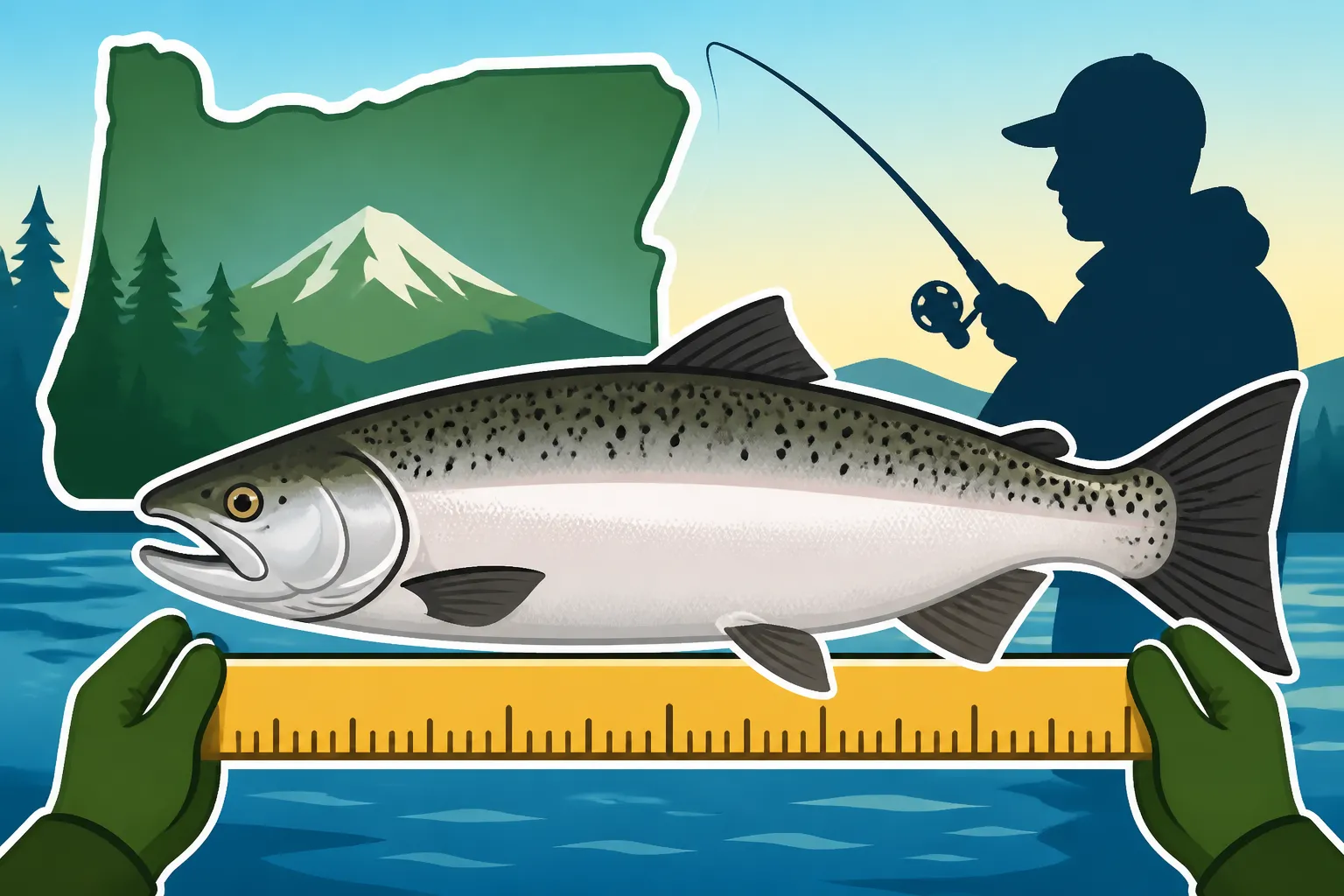
The standard method for measuring a fish in Oregon, including Chinook salmon, is from the tip of the nose (snout) to the fork of the tail (midline of the tail fin). This is often referred to as "fork length." It's important to understand this distinction because some regulations in other areas or for other species might refer to "total length" (to the longest tip of the tail). For Chinook in Oregon, it's almost always fork length.
Here's how to do it right:
- Prepare Your Measuring Device: Have a sturdy, easily readable measuring tape or a fish ruler clearly marked in inches. Many anglers have these mounted to their boat, cooler lid, or tackle box for quick access. For bank anglers, a soft measuring tape or a rigid ruler is essential.
- Handle the Fish Carefully: If you intend to keep the fish, land it safely and quickly. If you're unsure if it's legal size and might need to release it, prioritize keeping it in the water as much as possible, especially in warmer weather. A net with rubber mesh can be invaluable for minimizing scale and slime loss.
- Lay the Fish Flat: Place the fish on its side on a flat, wet surface with the measuring device alongside it. Ensure the nose is against a firm stop (like the end of your measuring board) or aligned perfectly with the zero mark of your tape.
- Compress the Tail (Gently): While keeping the nose at zero, gently squeeze the tail lobes together so the fork of the tail is clearly defined and aligned with the measurement. Don't stretch the fish or bend it unnaturally.
- Read the Measurement: Take a clear reading at the fork of the tail. If it’s exactly on the minimum legal length, you’re good to go. If it’s even a hair under, it’s a release. Always err on the side of caution.
Practicing this technique even with smaller, non-game fish can build confidence for when that big Chinook finally bites. Remember, speed and gentle handling are paramount, especially if the fish needs to be released.
What to Do with Sub-Legal Fish
It's inevitable: you'll catch a Chinook that's just a bit too short. It happens to the best of us! The key here is proper Oregon Catch-and-Release Rules. Releasing a fish safely and responsibly is just as important as knowing the legal size for keeping one. Mishandling a sub-legal fish can significantly reduce its chances of survival, which defeats the entire purpose of a size limit.
- Minimize Time Out of Water: The moment you determine a fish is sub-legal, get it back in the water. Prolonged air exposure is one of the biggest killers of released fish.
- Wet Hands/Gloves: Always wet your hands or use wet gloves before touching the fish. Dry hands can remove the protective slime layer, leaving the fish vulnerable to infection.
- Support Its Weight: If you must lift the fish, support its entire body horizontally, especially larger fish. Avoid holding it vertically by the tail or jaw only, as this can damage its internal organs and spine.
- Remove Hook Quickly: Use needle-nose pliers or a de-hooking tool to remove the hook efficiently. If the fish is deeply hooked and removal would cause excessive damage, cut the line as close to the hook as possible. Barbless hooks, which are often required in certain Oregon waters (e.g., for steelhead and salmon in some areas), make this much easier.
- Revive if Necessary: If the fish seems sluggish, hold it gently in the current, facing upstream, allowing water to flow over its gills. Move it back and forth slightly until it can swim away under its own power. Don't just toss it back; ensure it's strong enough to survive.
Releasing a sub-legal fish in good condition is a crucial part of being a responsible angler and contributes directly to the sustainability of Oregon's Chinook populations.
Common Misconceptions and Additional Considerations
Even seasoned anglers can sometimes get tripped up by the nuances of fishing regulations. When it comes to Chinook salmon, a few common points of confusion often arise, particularly regarding "jacks" and the ever-changing nature of the rules.
Jacks vs. Adults and Fin-Clipping
One of the most frequent sources of confusion for Chinook salmon regulations revolves around the distinction between "jacks" and "adults." A "jack" salmon is essentially a male salmon that returns to spawn a year or more earlier than its counterparts, often at a smaller size. For Chinook, jacks are typically defined as those under a certain length, commonly less than 24 inches, though this can vary by specific regulation.
Many regulations allow for the retention of hatchery-marked jack Chinook at a smaller minimum size (e.g., 12 inches) while requiring larger adult Chinook to meet the 24-inch mark. This is because jacks contribute less to the overall spawning success of a run compared to full-sized adults, and their harvest can provide additional recreational opportunity without significantly impacting the population.
The crucial element here is fin-clipping. To differentiate hatchery-reared fish from wild fish, hatchery salmon (including Chinook) are often marked by having their adipose fin removed. This small, fleshy fin located between the dorsal fin and the tail is typically clipped when the fish are very young. This "adipose fin clip" is your visual cue. If a fish is legal size, but it's a wild fish (meaning it still has its adipose fin), it will almost always need to be released, regardless of its size. Always check the regulations to confirm whether wild Chinook retention is permitted in your specific area and season. You can learn more about this distinction in our Chinook Salmon in Oregon guide.
Keeping Up with Regulation Changes
Here's the kicker: Oregon's fishing regulations are not static. Especially for highly managed species like Chinook salmon on major systems like the Columbia River, rules can change not just annually, but even in-season. These changes are usually driven by real-time data on fish returns, aiming to ensure conservation goals are met while maximizing fishing opportunities. This means that a regulation you knew last year, or even last month, might have been updated.
So, how do you stay current?
- Always Check the Current Regulation Booklet: The ODFW publishes a new fishing regulation booklet annually. Always have the most current version, either a physical copy or the PDF on your phone. Many tackle shops provide them for free.
- Visit the ODFW Website for Updates: The ODFW website is the most authoritative source for in-season regulation changes, emergency closures, and updated bag limits. They often have dedicated pages for major rivers like the Columbia that are updated weekly or even daily during peak seasons.
- Subscribe to ODFW News Releases: Many anglers find it helpful to subscribe to ODFW's email news releases for specific regions or fisheries. This is often how immediate changes, like emergency closures or season extensions, are communicated.
- Talk to Local Tackle Shops and Guides: Local bait and tackle shops and professional fishing guides are often the first to know about subtle changes or local interpretations of the rules. They can be an invaluable resource, but always back up their advice with an official ODFW check.
Understanding the Oregon Fishing Season Dates and Limits is a continuous process, and being proactive about checking for updates will prevent you from inadvertently violating a regulation. Fishing laws are complex because they are designed to protect precious resources while also providing recreational opportunities. Taking the time to understand them fully is part of being a responsible and successful angler in Oregon.
Disclaimer
Please note that fishing regulations, including minimum size limits, are subject to change. Always consult the most current Oregon Department of Fish and Wildlife (ODFW) sport fishing regulations before heading out on the water. This guide provides general information and should not be considered a substitute for the official ODFW regulations.