Oregon and Washington License Reciprocity on the Columbia
There’s nothing quite like standing on the banks of the mighty Columbia River, casting your line into its swirling waters, feeling that immense power flowing around you. But let's be real, that feeling of serene anticipation can quickly turn into a knot of anxiety when you start to second-guess whether your fishing license is actually valid. Is this Oregon water? Is that Washington? Do I need two licenses? It’s a common, incredibly frustrating hurdle for anglers wanting to enjoy one of the Pacific Northwest's most prolific fisheries. This guide is here to clear up the confusion surrounding Oregon and Washington fishing license reciprocity on the Columbia River, so you can focus on the tug on your line, not the worry in your gut.
The Frustration of Border Waters: Why Reciprocity Matters
Fishing the Columbia River is a dream for many, offering incredible opportunities for salmon, steelhead, sturgeon, and more. But the very thing that makes it so grand—its status as a natural boundary between two states—is also the source of endless headaches for anglers. You’re out there on the water, maybe drifting in a boat, or even just looking across to the other shore, and the question inevitably pops into your head: Am I legal here?
The Unique Challenge of the Columbia River
Think about it: the Columbia River isn’t just any river; it’s a massive, dynamic system that serves as the official border between Oregon and Washington for a significant stretch. One moment you might be technically in Oregon waters, and with a slight drift, you could be in Washington. This isn't like a small creek where the boundaries are clear. On the Columbia, especially in a boat, it's incredibly easy to cross an invisible line without even realizing it. This geographical reality makes understanding fishing regulations, particularly regarding licenses, an absolute necessity.
Many anglers find themselves constantly glancing at GPS devices or shoreline landmarks, trying to deduce which state's jurisdiction they're in. This takes away from the pure enjoyment of fishing and replaces it with a nagging sense of uncertainty. You want to focus on your retrieve, the feel of the current, and spotting that tell-tale rise, not constantly worrying about jurisdictional lines. This unique challenge is precisely why the concept of reciprocity was established, though as we'll see, it’s not as straightforward as many hope.
Why You Can't Just Have One License for Everywhere
At its heart, fishing licenses and their associated fees are crucial for funding conservation efforts, fish stocking programs, habitat restoration, and the enforcement of regulations. Both the Oregon Department of Fish and Wildlife (ODFW) and the Washington Department of Fish and Wildlife (WDFW) operate as independent regulatory bodies, each with its own budget, programs, and legal frameworks. When you purchase an Oregon fishing license, your money generally supports ODFW's initiatives within Oregon. The same goes for Washington.
Because these states are distinct entities, they naturally have their own rules, even when sharing a resource like the Columbia River. Historically, this would mean needing two licenses if you ever crossed the invisible state line on the river. Imagine the hassle and expense! Thankfully, the states recognized the unique situation of the Columbia and implemented a reciprocity agreement to simplify things for anglers on the mainstem. However, this agreement has specific boundaries, and it doesn't mean a single license covers every body of water or every species throughout both states. The individual state's need to manage its resources and collect funds for its specific programs is why these distinctions still exist. For a broader overview, take a look at our Oregon Fishing License Guide.
Understanding the Oregon-Washington Reciprocity Agreement
The good news is that for the vast majority of sport fishing on the mainstem Columbia River, you don't actually need two separate base angling licenses. Both Oregon and Washington have a standing agreement that aims to make fishing this incredible shared resource much more accessible. But, and this is a big "but," there are critical details you need to understand to avoid accidentally running afoul of the law.
The Core of the Agreement: What It Covers
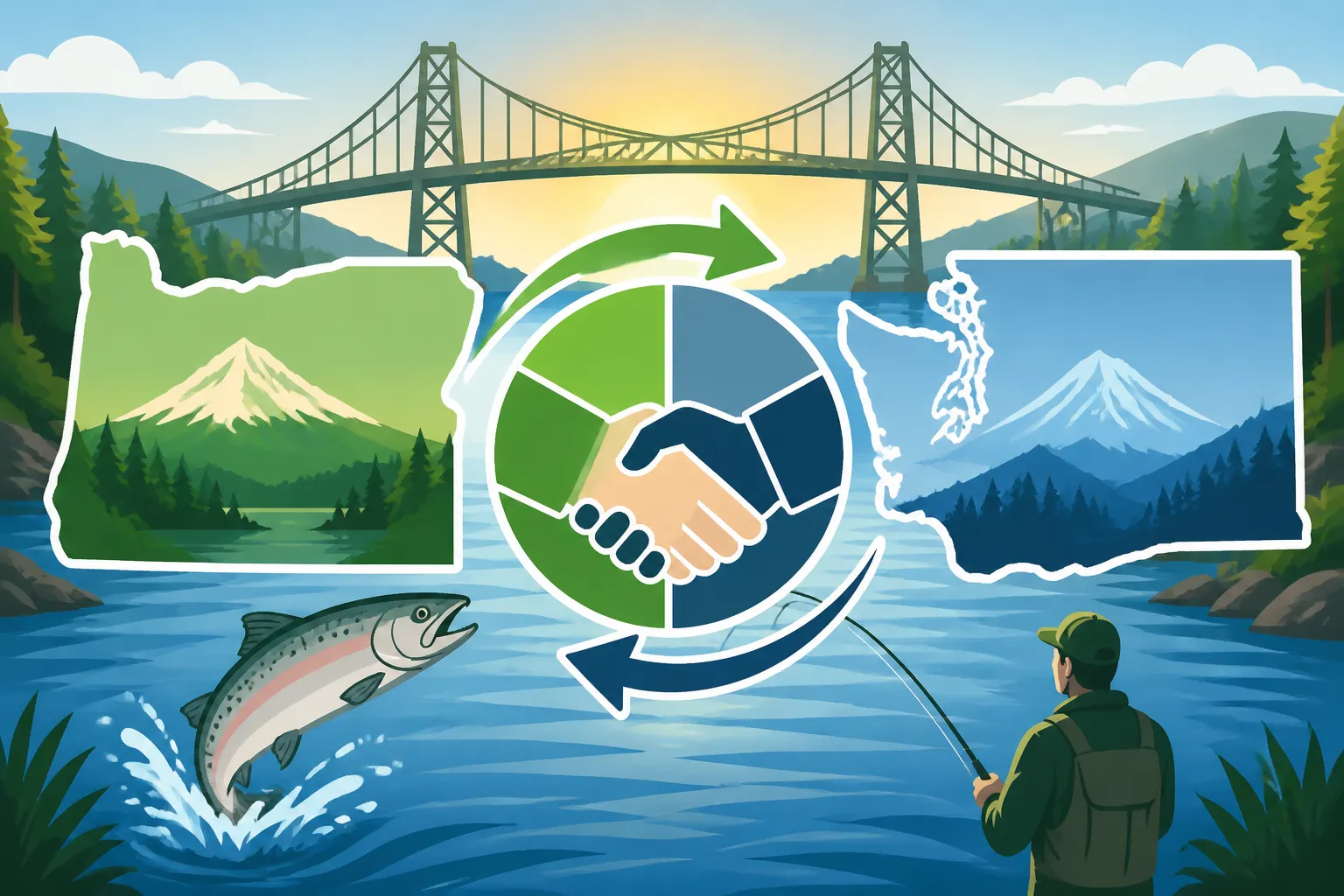
Simply put, a valid freshwater fishing license from either Oregon or Washington permits you to fish in the mainstem of the Columbia River that forms the boundary between the two states. This means if you have an annual Oregon angling license, you can fish from a boat anywhere in the main channel, regardless of whether you’re technically on the Oregon side or the Washington side. The same applies if you hold a Washington license. This reciprocity primarily covers the area from the mouth of the Columbia River upstream to McNary Dam.
This agreement is a huge relief for boat anglers, especially. Imagine trying to stay on one side of a wide, powerful river while fighting a fish or drifting with the current! The reciprocity agreement acknowledges this practical impossibility and makes the mainstem Columbia a shared jurisdiction for base license purposes. This means fewer worries about drifting over an invisible line and more focus on what matters – landing that trophy salmon or steelhead. It simplifies one of the core requirements, but as we'll delve into, this simplicity doesn't extend to everything.
The Catch: What It Doesn't Cover (and why it's tricky)
While the reciprocity for a base angling license on the mainstem Columbia is fantastic, it's absolutely crucial to understand its limitations. This is where most anglers get into trouble, often unintentionally. The agreement only applies to the mainstem of the Columbia River that serves as the border.
Here's where it gets tricky:
- Tributaries: Any river, creek, or slough that flows into the Columbia River is considered part of the state it's in. If you venture into the mouth of the Willamette River or the Cowlitz River, even just a few feet upstream from their confluence with the Columbia, you are no longer covered by the reciprocity agreement. You must have the license for the state whose waters you are in. So, an Oregon license is required for the Willamette, and a Washington license for the Cowlitz. This is a common mistake and one that can lead to fines if a game warden spots you.
- Bank Fishing: If you are physically standing on the bank of the Columbia River, you are considered to be in the state whose land you are on. Therefore, if you are bank fishing from the Oregon shore, you must have an Oregon fishing license. If you are bank fishing from the Washington shore, you must have a Washington fishing license. The reciprocity agreement for base licenses only applies when fishing from a boat within the main channel where the states share jurisdiction. This distinction is often overlooked and can cause issues for shore-bound anglers.
- State-Specific Regulations: While your base license might be reciprocal, the regulations you must follow depend on which state issued your license. If you have an Oregon license, you must abide by Oregon's daily bag limits, size restrictions, and gear rules when fishing the Columbia. If you have a Washington license, you follow Washington's rules. This often leads to needing to carry both states' regulation pamphlets or checking their online resources constantly, which we cover in our Oregon Fishing Regulations Explained guide. It's a bit of a dance, but understanding which rulebook applies to you is paramount.
This table highlights the core difference in what the reciprocity agreement covers for your base angling license:
| Feature | Mainstem Columbia River (Boat Fishing) | Mainstem Columbia River (Bank Fishing) | State Tributaries (e.g., Willamette, Cowlitz) |
|---|---|---|---|
| Oregon License Holder | Valid | Needs Oregon License | Needs Oregon License (if in OR tributary) |
| Washington License Holder | Valid | Needs Washington License | Needs Washington License (if in WA tributary) |
Navigating the Nuances: Endorsements and Tags
Here’s where the confusion often intensifies for anglers venturing onto the Columbia River: it's not just about the base fishing license. For certain species or specific fishing practices, both states require additional endorsements or tags. And unlike the base angling license, these often do not reciprocate. This is a critical distinction that can easily trip up even experienced anglers.
The Columbia River Basin Endorsement
Let’s talk about the Columbia River Basin Endorsement (CRBE). This endorsement is a mandatory purchase for any angler (resident or non-resident, youth or adult) who wishes to fish for salmon, steelhead, or sturgeon in the Columbia River and its tributaries, or use a Two-Rod Validation in the basin. This revenue helps fund ongoing conservation and recovery efforts specifically for these iconic fish runs within the Columbia River Basin.
Now, for the critical part about reciprocity: the Columbia River Basin Endorsement is not reciprocal.
- If you hold an Oregon fishing license, you must purchase the Oregon Columbia River Basin Endorsement from ODFW to fish for salmon, steelhead, or sturgeon in the mainstem Columbia River, or in Oregon tributaries.
- If you hold a Washington fishing license, you must purchase the corresponding Columbia River Endorsement from WDFW to fish for salmon, steelhead, or sturgeon in the mainstem Columbia River, or in Washington tributaries.
You cannot buy an Oregon CRBE and have it cover you while fishing with a Washington base license, and vice-versa. This means if you primarily fish the Columbia for these specific species, you need to ensure you have the CRBE that matches the state of your base angling license. For example, if you bought an Oregon Annual Angling License, you'd then need to add the Oregon CRBE if you plan on targeting salmon or steelhead in the mainstem. This is a prime example of where the states maintain their independent regulatory structures for specific conservation funding.
Salmon, Steelhead, and Sturgeon Tags: State-Specific Requirements
Beyond the CRBE, you'll find that individual species tags, particularly for salmon, steelhead, and sturgeon, are also strictly tied to the state that issued your base angling license. These tags are not just about collecting fees; they are crucial tools for state agencies to monitor harvest, collect vital biological data, and manage specific fisheries effectively.
Consider this: when you purchase an Oregon Combined Angling Tag Guide or specific Oregon Salmon and Steelhead Tag Requirements for Oregon, those tags are designed to track your harvest against Oregon's specific bag limits and seasons, even when fishing in the reciprocal waters of the Columbia. They come with an Oregon Catch Record Card, and you are expected to report your catch to ODFW.
The same principle applies to Washington. If you have a Washington license, you'll acquire Washington's catch record cards and must report your catches to WDFW, adhering to their state's regulations.
Key takeaway:
- Base License: Oregon or Washington license is valid on the mainstem Columbia (from a boat).
- Columbia River Basin Endorsement: Not reciprocal. You need the CRBE from the state that issued your base license.
- Species Tags (Salmon, Steelhead, Sturgeon, Halibut): Not reciprocal. You need the specific tags/catch cards from the state that issued your base license, and you must follow that state's regulations for harvest, even on reciprocal waters. For example, if you have an Oregon license and catch a legal Chinook salmon on the Columbia, you'd use your Oregon salmon tag and adhere to Oregon's daily bag limits for that species. If you had a Washington license, you'd use your Washington tag and adhere to Washington's limits.
This distinction is perhaps the most important one to grasp. Many an angler has mistakenly assumed that because their base license is good, all associated tags and endorsements are too. This is not the case, and getting caught with a salmon on an invalid tag is a quick way to earn a hefty fine, which you can learn more about in our guide on Fishing Without a License Penalties in Oregon. Always double-check which state's regulations apply to your license and tags, especially when targeting prized species like salmon and steelhead.
Practical Scenarios and Common Mistakes
Understanding the rules in theory is one thing, but applying them in real-world fishing scenarios on the Columbia River can still feel like navigating a minefield. Let's walk through some common situations that often lead to confusion or unintentional violations.
Fishing from a Boat on the Columbia
This is where the reciprocity agreement shines the brightest and is generally the least confusing scenario for the base angling license.
- You have an Oregon license: You launch your boat from a ramp in Portland. You then motor up or down the mainstem Columbia, fishing anywhere in the main channel from bank to bank (from the mouth upstream to McNary Dam). Your Oregon license is valid for the base angling privilege. You must, however, adhere to Oregon's fishing regulations for gear, bag limits, and seasons. If you're targeting salmon, steelhead, or sturgeon, you also need an Oregon Columbia River Basin Endorsement and the appropriate Oregon harvest tags, and you'll record your catch on your Oregon catch card.
- You have a Washington license: You launch your boat from a ramp in Vancouver, Washington. You then fish anywhere in the mainstem Columbia, just like the Oregon license holder. Your Washington license is valid for the base angling privilege. You must follow Washington's fishing regulations for gear, bag limits, and seasons. For salmon, steelhead, or sturgeon, you'll need a Washington Columbia River Endorsement and Washington harvest tags, reporting your catch on a Washington catch card.
Common Mistake: Assuming that because your base license is reciprocal, you can simply follow the most lenient regulations of either state. This is incorrect. You always follow the regulations of the state that issued your base license and tags. If you have an Oregon license, you follow Oregon's rules, even if Washington has different (or more generous) limits that day.
Bank Fishing on Either Side
Bank fishing is where the reciprocity agreement for the base license does not apply, and it's a very frequent source of misunderstanding.
- Fishing from the Oregon bank: If your feet are on solid Oregon ground (or a dock physically attached to Oregon land), you must have an Oregon fishing license. It doesn't matter if you're casting into the mainstem Columbia; your physical location dictates your license requirement.
- Fishing from the Washington bank: Similarly, if you are standing on Washington soil, you must have a Washington fishing license.
Why this matters: A game warden patrolling the banks will check your license based on the state you are physically in. They won't care that you have a valid license from the other state. Your location is the key. So, if you're planning a bank fishing trip, be absolutely certain which state's shoreline you'll be on and purchase the appropriate Oregon Fishing License Types Explained beforehand. Many recreational areas along the Columbia, like those managed by state parks or counties, will clearly be in one state or the other.
Fishing a Tributary
This is perhaps the simplest rule but also one of the most commonly violated, again, due to the proximity to the reciprocal waters.
- No Reciprocity Here: Any tributary that flows into the Columbia River, such as the Willamette River, Deschutes River, Sandy River, or Lewis River (Washington), Cowlitz River (Washington), or Kalama River (Washington), is governed exclusively by the regulations and licensing requirements of the state it resides in.
- If you pull your boat into the mouth of the Willamette River, even just a few yards upstream, you are now in Oregon waters and must have an Oregon fishing license. Your Washington license is no longer valid.
- If you cruise into the mouth of the Cowlitz River, you are in Washington waters and must have a Washington fishing license. Your Oregon license is no longer valid.
Crucial Advice: Always consult the specific state's regulations for any tributary you plan to fish. Seasons, bag limits, and gear restrictions can vary wildly from the mainstem Columbia and between the states themselves. This also applies to special endorsements or tags. For instance, fishing for spring Chinook on the Willamette requires specific Oregon tags and adherence to Oregon Fishing Season Dates and Limits for that river, distinct from the Columbia.
Keeping Up-to-Date with Regulations
If you've been fishing the Columbia for any length of time, you already know that regulations are not static. They can change frequently, sometimes even mid-season, due to a variety of factors. This constant flux can be incredibly frustrating for anglers who just want to enjoy their hobby without having to be a legal scholar.
Why Regulations Change (and often)
The primary reason for frequent regulation changes, especially on a shared fishery like the Columbia River, is fish management and conservation. Salmon, steelhead, and sturgeon runs are dynamic. Their numbers can fluctuate dramatically year to year, influenced by ocean conditions, river flows, habitat changes, and previous harvest levels. Both ODFW and WDFW, along with federal agencies and tribal co-managers, continuously monitor these populations.
When fish returns are lower than expected, agencies might implement emergency closures, reduce bag limits, or restrict gear types to protect the resource. Conversely, if a run is exceptionally strong, they might open up additional days or increase limits. These changes are often decided in joint meetings between Oregon and Washington fishery managers. The goal is always to balance angler opportunity with the long-term health of the fish populations. This dynamic management, while essential for sustainability, means anglers must remain vigilant and check for updates regularly.
Best Resources for Current Information
Given the fluid nature of Columbia River fishing regulations, relying on outdated information is a surefire way to get a ticket or, worse, harm a vulnerable fish stock.
Here are the most reliable resources:
-
Official State Agencies:
- Oregon Department of Fish and Wildlife (ODFW): Their website is an invaluable resource. Look for their "Recreational Fishing" section, and specifically the "Columbia River Zone" regulations. They often have dedicated pages for in-season updates and emergency regulations.
- Washington Department of Fish and Wildlife (WDFW): Similar to ODFW, WDFW’s website is the authoritative source for Washington's rules. Check their "Fishing" section and look for the "Columbia River" rules and "Emergency Rules" alerts.
- Joint State Hotlines: Both states often operate joint "fishing hotlines" during peak seasons that provide recorded messages with the latest Columbia River regulations. These are excellent for quick checks before heading out.
-
Local Tackle Shops and Marinas: The folks working at your local bait and tackle shops near the Columbia River, whether in Astoria, The Dalles, or Vancouver, are often the most up-to-date sources of real-time information. They live and breathe fishing and are usually the first to hear about emergency regulation changes. Places like Fisherman's Marine & Outdoor or Bob's Sporting Goods often have staff who are also guides and intimately familiar with the latest rules. Plus, they can offer advice on what's biting!
-
Online Forums and Social Media (with caution): While useful for camaraderie and tips, always cross-reference any information found on fishing forums or social media groups with official state sources. Misinformation can spread quickly.
-
Fishing Regulation Booklets: Both ODFW and WDFW publish annual fishing regulation booklets. While these are great starting points, remember they are printed well in advance and may not reflect in-season changes. Always check for updates online. You can often pick up physical copies at license vendors, or sometimes find them listed on sites like Amazon if you prefer a print version to keep in your tackle box as a general reference.
Staying informed is your responsibility as an angler. Make it a habit to check the official sources right before each trip to the Columbia.
Making the Choice: Oregon or Washington License?
So, you understand the reciprocity agreement, you know about the endorsements and tags, and you're committed to staying updated. Now comes the practical decision: which state's license should you buy if you plan to fish the Columbia River? For many, this isn't just a matter of preference but a strategic choice based on cost, convenience, and primary fishing habits.
Resident vs. Non-Resident Costs
The price difference between a resident and a non-resident fishing license in either state can be substantial. Both Oregon and Washington offer various license types, including annual, multi-day, and youth options.
Let's look at a general comparison (always check current ODFW and WDFW websites for exact up-to-date pricing, as prices can change year-to-year, sometimes even for 2026 licenses):
| License Type | Oregon Resident (Approx.) | Washington Resident (Approx.) | Oregon Non-Resident (Approx.) | Washington Non-Resident (Approx.) |
|---|---|---|---|---|
| Annual Angling License | $44.00 | $30.40 | $100.00 | $84.50 |
| Annual CRBE | $9.75 | $9.00 | $9.75 | $9.00 |
| Annual Combination (Hunt/Fish) | $73.00 | $70.80 | N/A | N/A |
| 1-Day Angling License | $23.00 | $12.40 | $23.00 | $12.40 |
| 3-Day Angling License | N/A | $20.00 | N/A | $20.00 |
Note: These prices are estimates and should be verified with ODFW and WDFW directly.
As you can see, for residents, Washington often has slightly lower base angling license costs, but both states have similar CRBE prices. For non-residents, the difference is more pronounced, with Washington typically being less expensive for an annual license. However, if you're only visiting for a short period, a 1-day or multi-day license might be more economical. For more detail on Oregon's specific costs, check out our articles like Oregon Resident Fishing License Cost and Oregon Nonresident Fishing License Cost.
If you live in Oregon, buying an Oregon license is a no-brainer due to the resident pricing. The same goes if you reside in Washington. The choice primarily becomes a strategic one for non-residents, or for residents who live very close to the border and primarily fish one side's tributaries.
Where You Primarily Fish
This is arguably the most important factor in deciding which license to purchase. Think about your typical fishing habits:
- If you primarily fish Oregon's tributaries (e.g., Willamette, Sandy, Deschutes) and only occasionally venture onto the mainstem Columbia: An Oregon fishing license is your best bet. It will cover you for all Oregon waters and provide the reciprocal base angling privilege on the Columbia. You'll need Oregon's CRBE and Oregon tags. This simplifies things greatly.
- If you primarily fish Washington's tributaries (e.g., Cowlitz, Kalama, Lewis) and only occasionally fish the mainstem Columbia: Then a Washington fishing license makes the most sense. It covers all Washington waters and provides reciprocity on the Columbia. You'll need Washington's CRBE and Washington tags.
- If you only fish the mainstem Columbia River from a boat and never fish any tributaries or from the bank: In this specific scenario, either an Oregon or Washington base angling license will technically suffice for the reciprocal waters. Your decision might then come down to cost (especially for non-residents) or which state's specific harvest regulations (for salmon, steelhead, sturgeon) you find easier to follow or more favorable for your target species. You would still need the CRBE and species tags from the state that issued your base license. For instance, if you get a Washington license, you must buy Washington's CRBE and Washington's salmon/steelhead tags.
Also consider convenience for purchase and renewal. Both states offer online purchasing options, making it quite easy to get your license from anywhere. For example, you can learn How to Renew an Oregon Fishing License Online from the comfort of your home. You can also buy licenses at local sporting goods stores or other licensed vendors in either state. Many anglers like the convenience of buying their tackle and license at the same time, perhaps even adding some fishing gadgets or a new regulation book they found on Amazon.
Ultimately, the best approach is to consider your primary fishing grounds, where you reside, and the overall cost structure of the licenses, endorsements, and tags from each state. It usually boils down to choosing the state that encompasses the majority of the waters you wish to fish beyond just the mainstem Columbia.
Disclaimer
Please remember that fishing regulations, including those pertaining to licenses and reciprocity, can change. While every effort has been made to provide accurate and up-to-date information, this guide is for informational purposes only. It is the individual angler's responsibility to consult the most current regulations directly from the Oregon Department of Fish and Wildlife (ODFW) and the Washington Department of Fish and Wildlife (WDFW) websites or official publications before engaging in any fishing activity.